HNY Policy and Pathway Repository - North Yorkshire
Suspected gynaecological cancer
Definition/Description
None provided
Red Flag Symptoms
None provided
Guidelines on Management
Patient engagement
- The patient has been informed that the reason for referral is to rule out or rule in Cancer.
- Supporting information (leaflet) provided
- The patient has been informed of the likely next pathway steps and the time in which they should be contacted?
- The patient has confirmed that they are willing and available to be contacted and attend the hospital for appointments and tests within the required timeframes?)
Ovarian cancer
NICE NG12 (updated April 2026) Symptoms suggesting ovarian cancer include persistent/frequent (particularly >12 times/month) abdominal distension/bloating, early satiety or loss of appetite, pelvic/abdominal pain, and urinary urgency/frequency. Also consider testing with unexplained weight loss, fatigue or change in bowel habit. In people aged 50 or over, new IBS-type symptoms within the last 12 months warrant ovarian cancer testing. Referral / investigation pathway:
|
|
- If CA125 is below the age-specific threshold, or meets the threshold but ultrasound is normal: investigate other potential causes of symptoms as appropriate. If no other cause is identified, advise the patient to return for reassessment if symptoms persist, become more frequent or worsen.
Endometrial cancer
NICE NG12 (updated April 2026)
|
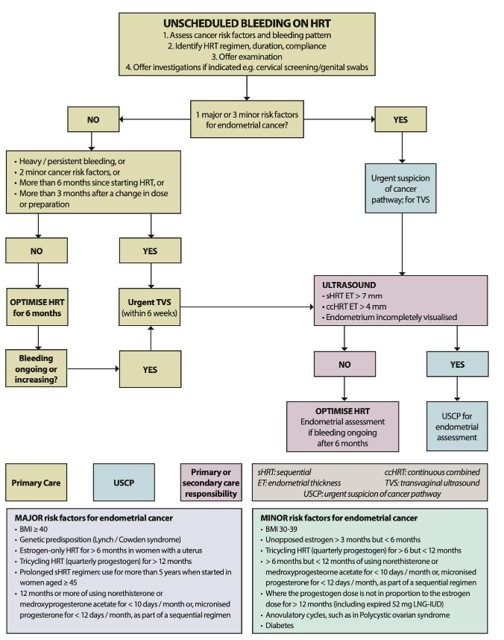
- Unscheduled bleeding on HRT: NICE signposts to British Menopause Society guidance. Follow the current BMS pathway/flowchart below (reviewed May 2026).
Cervical cancer
NICE: consider suspected cancer pathway referral if the appearance of the cervix is consistent with cervical cancer. |
Local pathway advice: cervical ectropion and uncomplicated cervical polyps should not be referred via this pathway unless the cervical appearance is suspicious for cancer; use the appropriate routine gynaecology pathway if assessment is required.
Vulval / vaginal cancer
Vulval – NICE: consider suspected cancer pathway referral for an unexplained vulval lump, ulceration or bleeding. |
Vaginal – NICE: consider suspected cancer pathway referral for an unexplained palpable mass in or at the entrance to the vagina.
Referral Criteria/Information
Ovarian cancer
- Physical examination identifies ascites and/or a pelvic or abdominal mass that is not obviously uterine fibroids.
- Ultrasound scan of the abdomen and pelvis suggests ovarian cancer.
- Raised CA125 alone is not a referral criterion. Follow the age-specific NICE primary-care CA125/ultrasound pathway below; refer if ultrasound suggests ovarian cancer.
Endometrial cancer
Cervical cancerConsider suspected cancer pathway referral if, on examination, the appearance of the cervix is consistent with cervical cancer. Vulval / vaginal cancer
If the patient does not meet NICE suspected cancer referral criteria but there remains significant clinical concern, please provide full details in the referral letter. Local pathway criteria may also apply.
Rockwood clinical frailty score (to include on referral letter)
|
Additional Resources & Reference
Associated Policies
Places covered by
- North Yorkshire
Hospital Trusts
Harrogate and District