HNY Policy and Pathway Repository - Humber
Management of Shoulder Pain in Primary Care (NL NEL)
Definition/Description
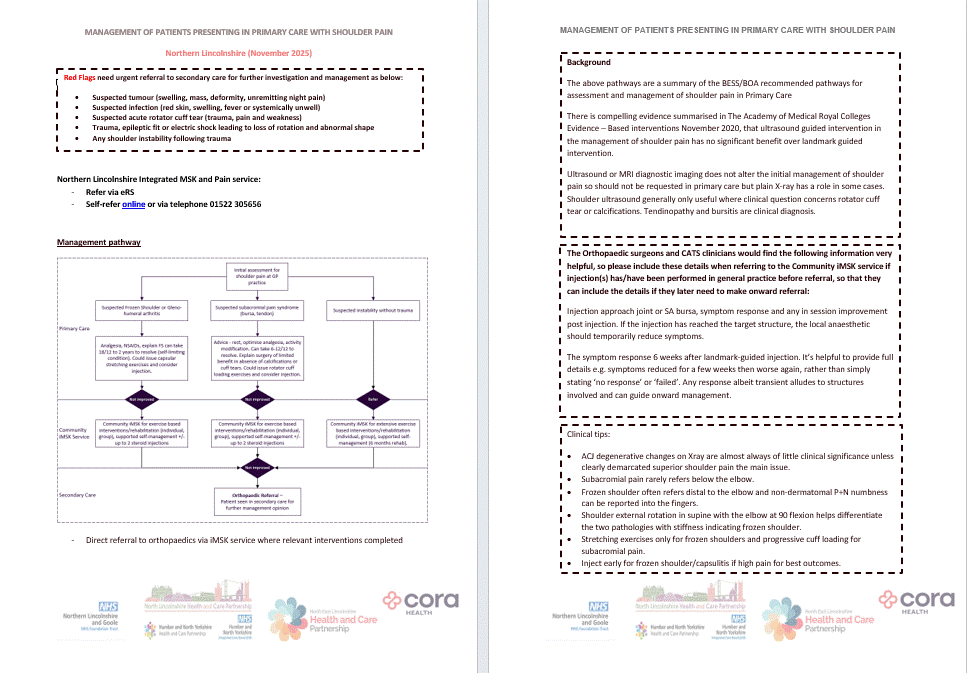
The above pathways are a summary of the BESS/BOA recommended pathways for assessment and management of shoulder pain in Primary Care
There is compelling evidence summarised in The Academy of Medical Royal Colleges Evidence – Based interventions November 2020, that ultrasound guided intervention in the management of shoulder pain has no significant benefit over landmark guided intervention.
Ultrasound or MRI diagnostic imaging does not alter the initial management of shoulder pain so should not be requested in primary care but plain X-ray has a role in some cases. Shoulder ultrasound generally only useful where clinical question concerns rotator cuff tear or calcifications. Tendinopathy and bursitis are clinical diagnosis.
The Orthopaedic surgeons and CATS clinicians would find the following information very helpful, so please include these details when referring to the Community iMSK service if injection(s) has/have been performed in general practice before referral, so that they can include the details if they later need to make onward referral:
Injection approach joint or SA bursa, symptom response and any in session improvement post injection. If the injection has reached the target structure, the local anaesthetic should temporarily reduce symptoms.
The symptom response 6 weeks after landmark-guided injection. It’s helpful to provide full details e.g. symptoms reduced for a few weeks then worse again, rather than simply stating ‘no response’ or ‘failed’. Any response albeit transient alludes to structures involved and can guide onward management.
Red Flag Symptoms
Red Flags need urgent referral to secondary care for further investigation and management as below:
- Suspected tumour (swelling, mass, deformity, unremitting night pain)
- Suspected infection (red skin, swelling, fever or systemically unwell)
- Suspected acute rotator cuff tear (trauma, pain and weakness)
- Trauma, epileptic fit or electric shock leading to loss of rotation and abnormal shape
- Any shoulder instability following trauma
Guidelines on Management
Clinical tips:
- ACJ degenerative changes on Xray are almost always of little clinical significance unless clearly demarcated superior shoulder pain the main issue.
- Subacromial pain rarely refers below the elbow.
- Frozen shoulder often refers distal to the elbow and non-dermatomal P+N numbness can be reported into the fingers.
- Shoulder external rotation in supine with the elbow at 90 flexion helps differentiate the two pathologies with stiffness indicating frozen shoulder.
- Stretching exercises only for frozen shoulders and progressive cuff loading for subacromial pain.
Inject early for frozen shoulder/capsulitis if high pain for best outcomes
Referral Criteria/Information
AS per pathway
Associated Policies
Places covered by
- North East Lincolnshire
- North Lincolnshire
Hospital Trusts
-
Northern Lincolnshire & Goole